
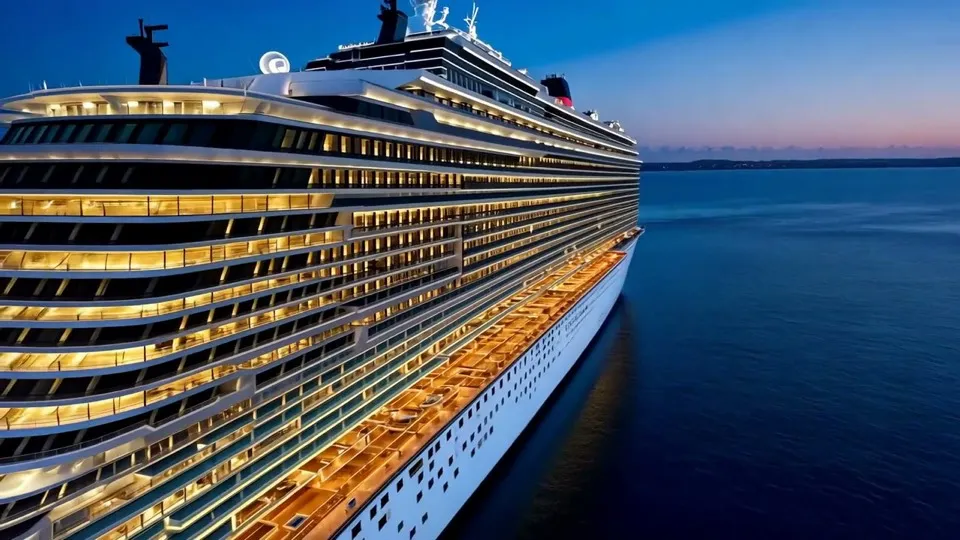

See how VGV helped a global cruise line evolve a text-based AI assistant into a visual, generative concierge that moves guests closer to booking.
- Booking conversion, driven by agentic search
- 1.00% → 1.08%
- Estimated ticketing revenue from that lift
- $536M
- Approved catalog items the model can assemble
- 14
One guest request, answered two ways. A switch flips between the text-based agent, which replies with long paragraphs of itineraries, balcony cabin prices and booking links, and the GenUI concierge in the VGV Voyage app, where the context bar picks up dates, destinations, cabin types and travelers and the answer is a set of cruise cards: 7-Night Mexican Riviera on VGV Pacific from San Pedro, April 5 to 12, 2026, two balcony cabins available, $1,249 per person, and 5-Night Baja Getaway on VGV Horizon from San Diego, April 8 to 13, 2026, two balcony cabins available, $899 per person. View Details on a card writes the guest’s next message.
- Dates
- Destinations
- Ships
- Cabin Types
- Budget
- Travelers
I need to book a cruise with two balcony cabins leaving out of San Pedro or San Diego in April 2026.

I found some great options for you! Here are the best cruises matching your criteria:
Cruises from California
-
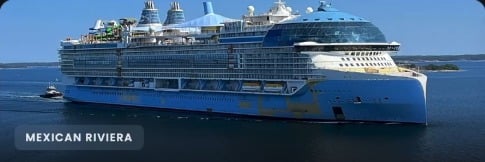
7-Night Mexican Riviera
VGV Pacific
San Pedro · Apr 5–12, 2026
✓2 Balcony cabins available
$1,249 /person
-
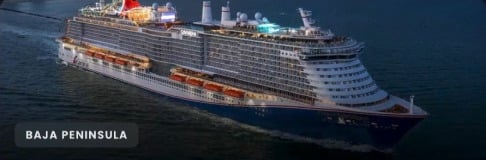
5-Night Baja Getaway
VGV Horizon
San Diego · Apr 8–13, 2026
✓2 Balcony cabins available
$899 /person


Built with GenUI by Very Good Ventures
01At a glance
Charting a new course
-
01
The challenge
One of the world’s largest cruise lines had one of the first agentic assistants in cruise. But it answered in long paragraphs and deep-linked guests out of the experience to book.
-
02
Our approach
We guided the cruise line through Structured Creativity: user context, a catalog of approved UI components, and prompt rules that enforce behavior and brand voice. We then built a GenUI prototype so the team could experiment with the technology and test latency concerns.
-
03
The results
As part of the cruise line’s larger effort to build agentic discovery into its booking flow, booking conversion rose from 1.00% to 1.08%, an estimated $536 million in ticketing revenue. Our work gave the team a governed model for generative UI.
02The challenge
An early agentic leader, still answering in text
One of the world’s largest cruise lines moved early. Its AI assistant was one of the first agentic experiences in the cruise industry. Guests could ask rich planning questions and get real answers.
The answers were the problem. The assistant replied with long, information-dense paragraphs. When a guest was ready to act, it deep-linked into the existing website, pulling them out of the agentic experience and back into the same multi-step funnel every other guest used.
The cruise line wanted to explore how vacation discovery could become more visual. Could an LLM generate UI elements, not just text, that move prospective guests closer to booking?
In their words
-

“VGV is leading the charge in how a structured approach can help enterprises embrace GenUI.”
Group Product Manager, Google Seth Ladd
03Before and after
From a text-only agent to a visual, generative concierge
Before
Text-based agent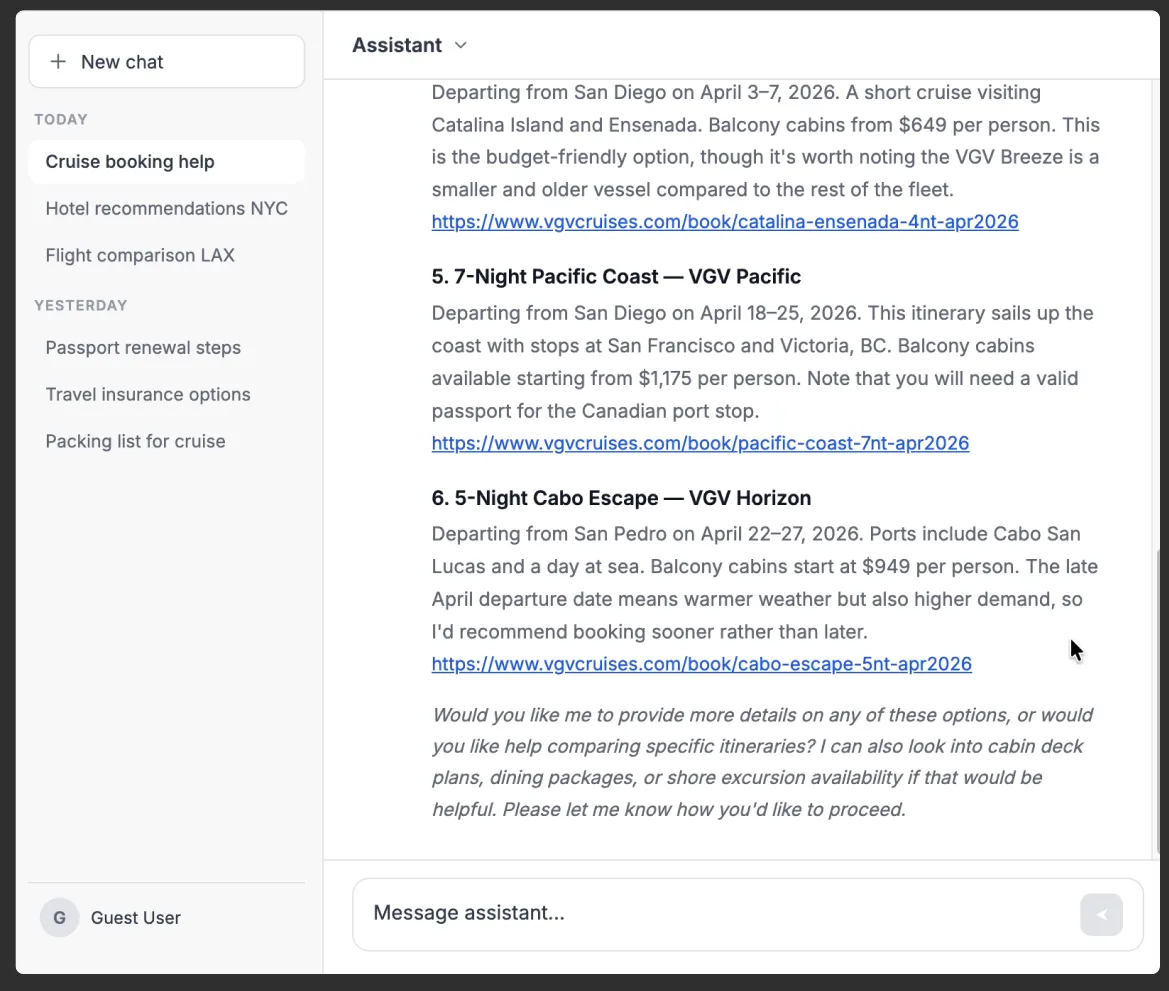
After VGV’s design and prototyping work
VGV envisions a GenUI-empowered discovery flow that uses visual cards, such as ship details and next best actions, to drive booking forward.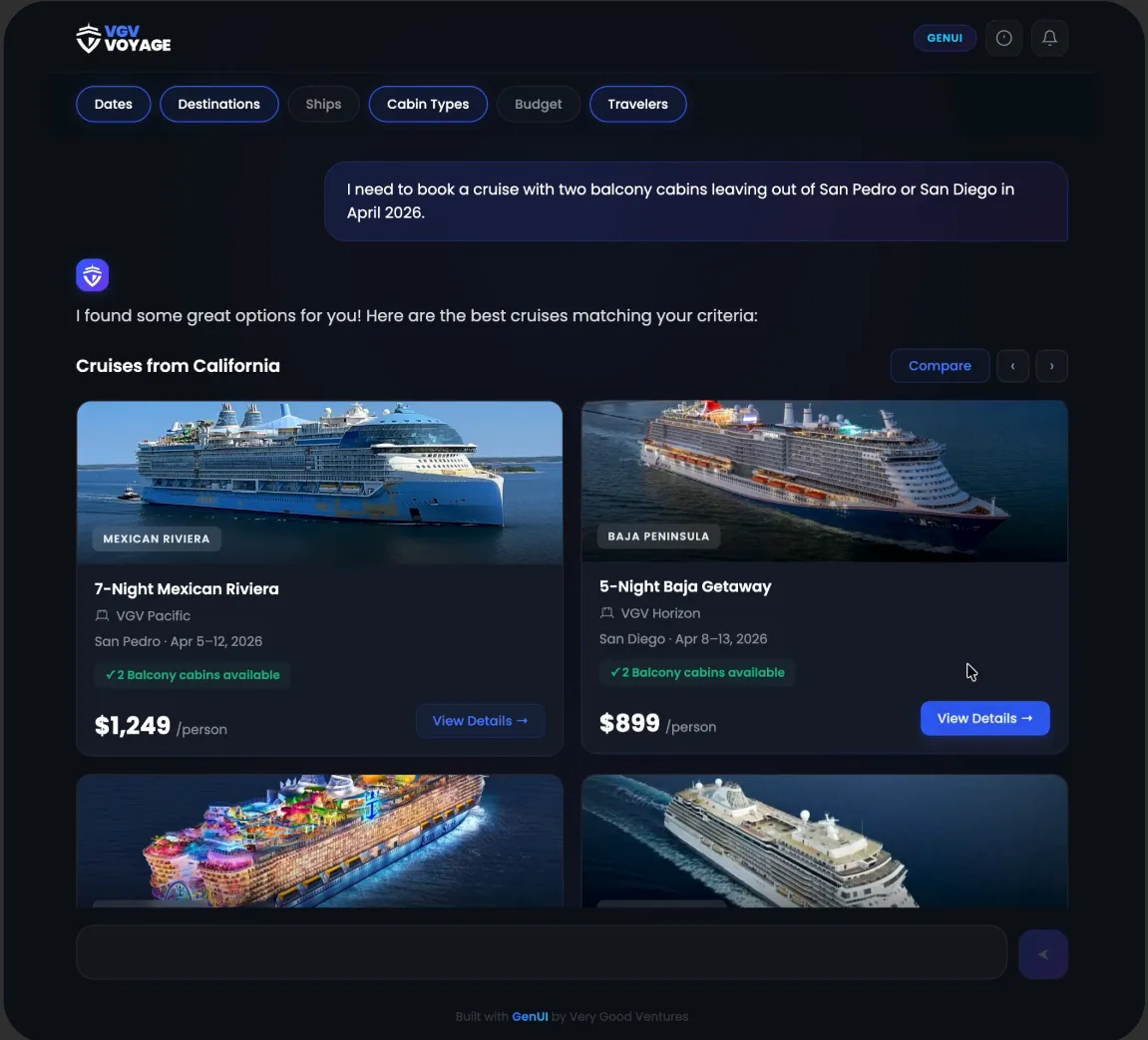
04Our approach
Listening before building
We started by listening. We met with the cruise line’s engineering, product, and design stakeholders to map constraints and find where GenUI could add value. We reviewed analytics on how the existing assistant flow affected booking conversion, and read real guest conversations to see what people actually ask.
We also worked directly with the Flutter team, which gave us early guidance on the Flutter GenUI SDK and a hand in shaping it.
05Structured Creativity
Three domains, one governed system
We guided the cruise line’s stakeholders through Structured Creativity, our process for designing GenUI that adapts to each guest without losing the brand. It works through three domains:
- 01
User context. What user context and data can we collect to shape each response?
- 02
Catalog. What is the visual catalog of UI components the model is allowed to use?
- 03
System prompt. What goes into the prompt to guide and enforce behavior and brand voice?
- 6 Message archetypes that shape every response
Structured Creativity: three domains feed one governed system. User Context personalizes based on user state, Catalog Items ensure strictly on-brand elements, System Prompt enforces behavior and brand voice. Pick a domain to see its question.
Structured Creativity
06Catalog
A catalog in the cruise line’s brand, fueled by context
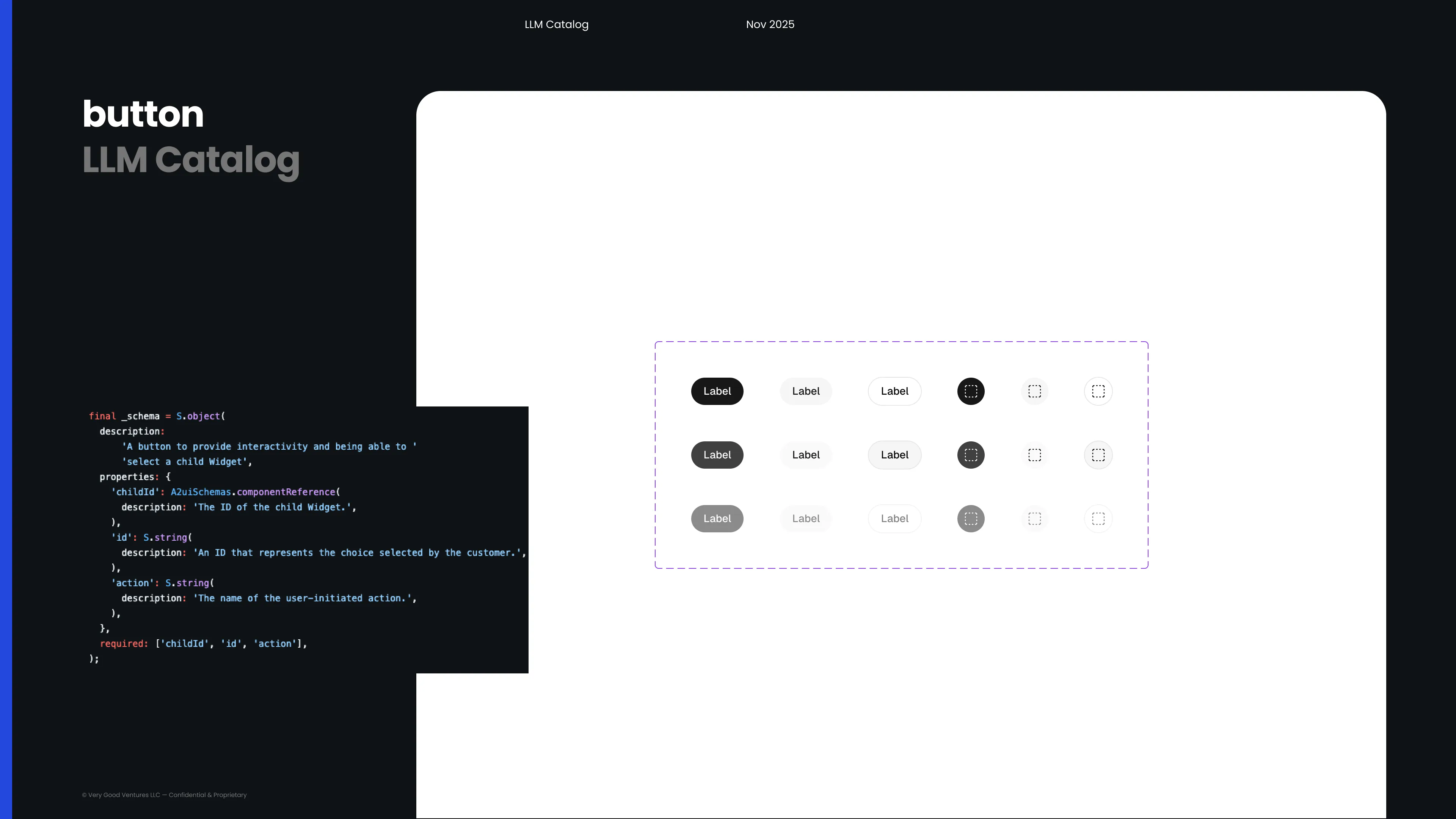
The catalog is the set of pieces the model can assemble: destination cards, itinerary groups, ship comparisons, date pickers, step summaries, and more. Each item carries usage instructions, so the brand always looks and sounds like itself.
Context decides what to build for each guest. In the POC, it came from chat messages and a context bar that updates from the guest’s first request. Tapping a component writes the guest’s next message, so the conversation keeps moving without typing.
07Architecture
An architecture built for speed
Latency was a real concern, so the technical architecture was a key part of the work. We designed GenUI as an agent layer on top of what the cruise line already runs. The existing assistant drafts its response, a GenUI model chooses the layout and catalog items, and the Flutter GenUI SDK renders interactive UI in real time.
Because the layer sits beside the assistant’s backend rather than inside it, any of the cruise line’s product teams can plug in the same capability. One Dart and Flutter codebase renders across web, mobile, and kiosk.
Integrated GenUI Technical Architecture: the Flutter app and its widget catalog from VGV over the cruise line’s backend services, where an orchestration agent calls reservations, booking and product services, OpenAI models, and a GenUI BFF that talks to Gemini 2.5 from Google, with the note that this architecture allowed the cruise line to capitalize on existing investments. Pick VGV, Cruise or Google in the legend to light that side.

Google · Flutter & GenUI collaboration
Built alongside the team behind Flutter and GenUI
VGV works directly with Google’s Flutter team. On this engagement, that collaboration gave us early guidance on the Flutter GenUI SDK and a hand in shaping it. Google also worked with the cruise line and VGV to uncover and test latency in the prototype.
08The prototype
Prototyping to explore latency issues
VGV delivered a working prototype that used GenUI and low-fidelity UI elements as a step toward the cruise line’s ultimate vision.
The prototype also helped the cruise line, VGV, and Google uncover latency issues. Some visual responses took up to 30 seconds to arrive from the LLM. As of late 2026, VGV has brought those latency benchmarks under 4 seconds.
09Where this goes next
Beyond booking
Booking was the starting point, not the boundary. VGV helped the cruise line conceptualize how the same governed system of system prompt, catalog, and context could shape the rest of the cruise experience, from choosing a sailing to ordering onboard to exploring a port from the cabin.
Each concept runs on the same three inputs as the POC. That gives the cruise line one model for adding AI to guest experiences that stays on-brand, governable, and portable across every screen it owns.
-
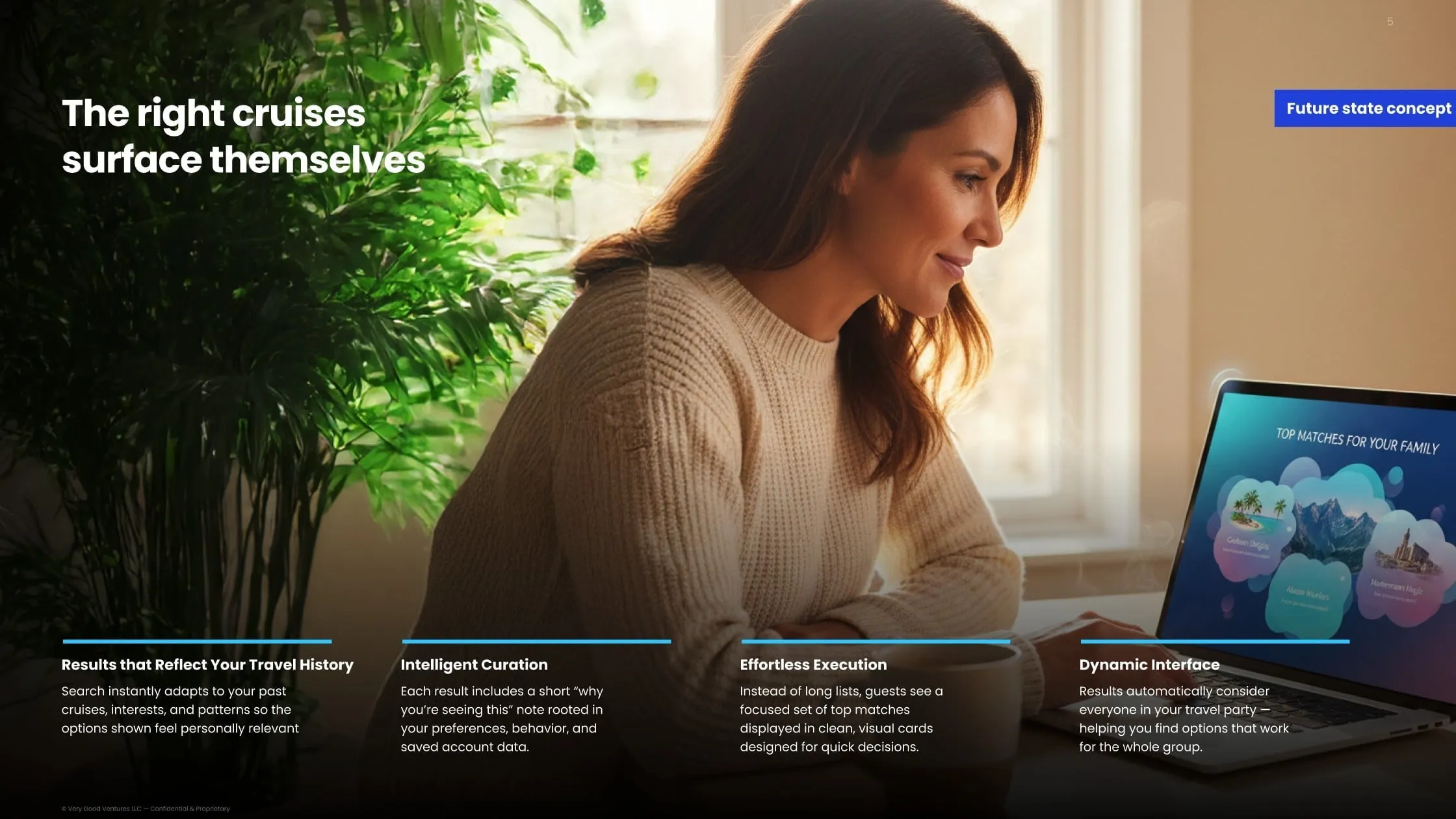
Search that knows you
Results adapt to past cruises, interests, and the whole travel party. Each result explains why it appears, and guests see a short set of top matches instead of a long list.
-
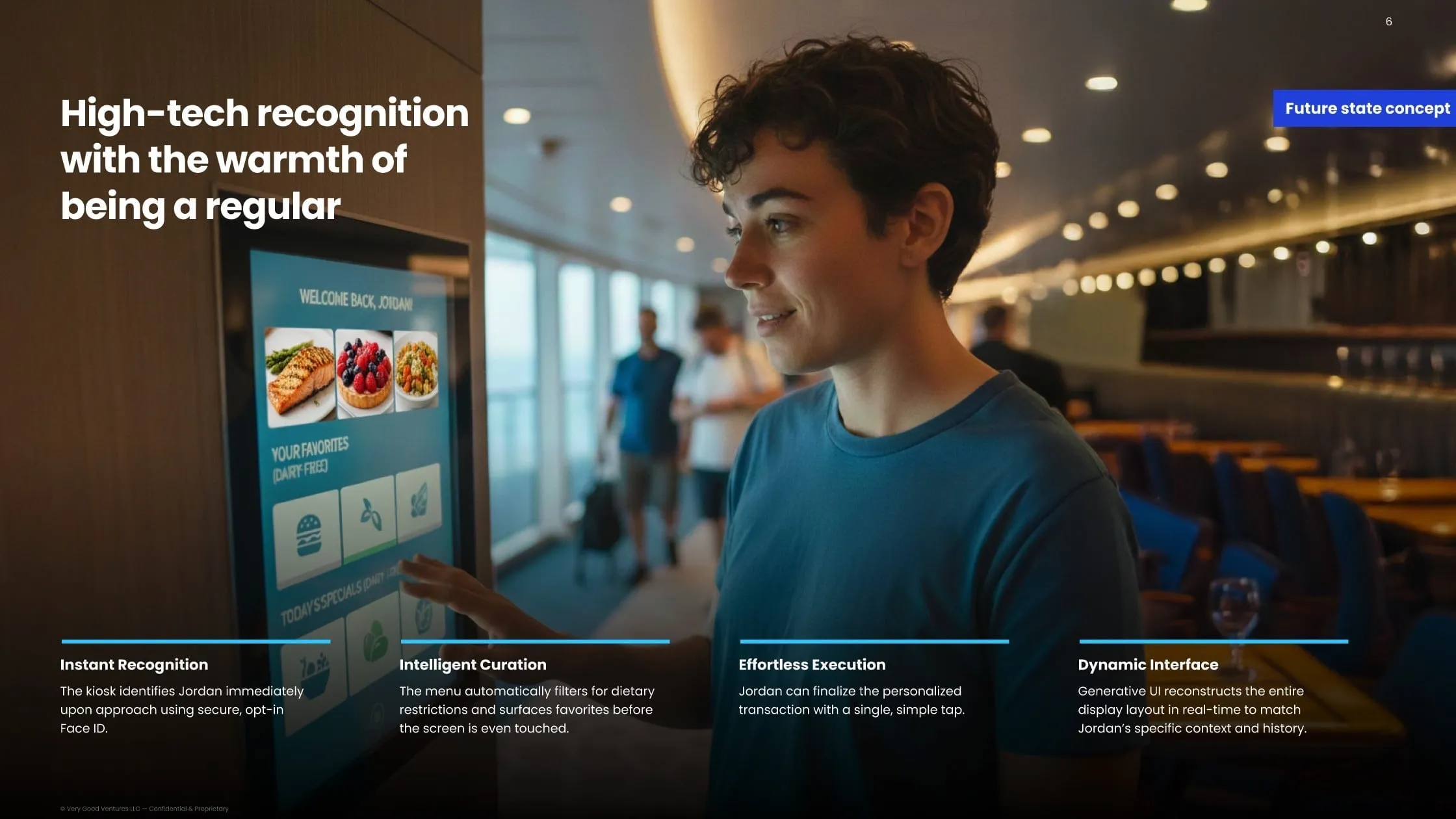
A kiosk that recognizes regulars
With opt-in recognition, an onboard kiosk filters the menu for dietary needs and surfaces favorites. The layout rebuilds around the guest’s history, and one tap completes the order.
-
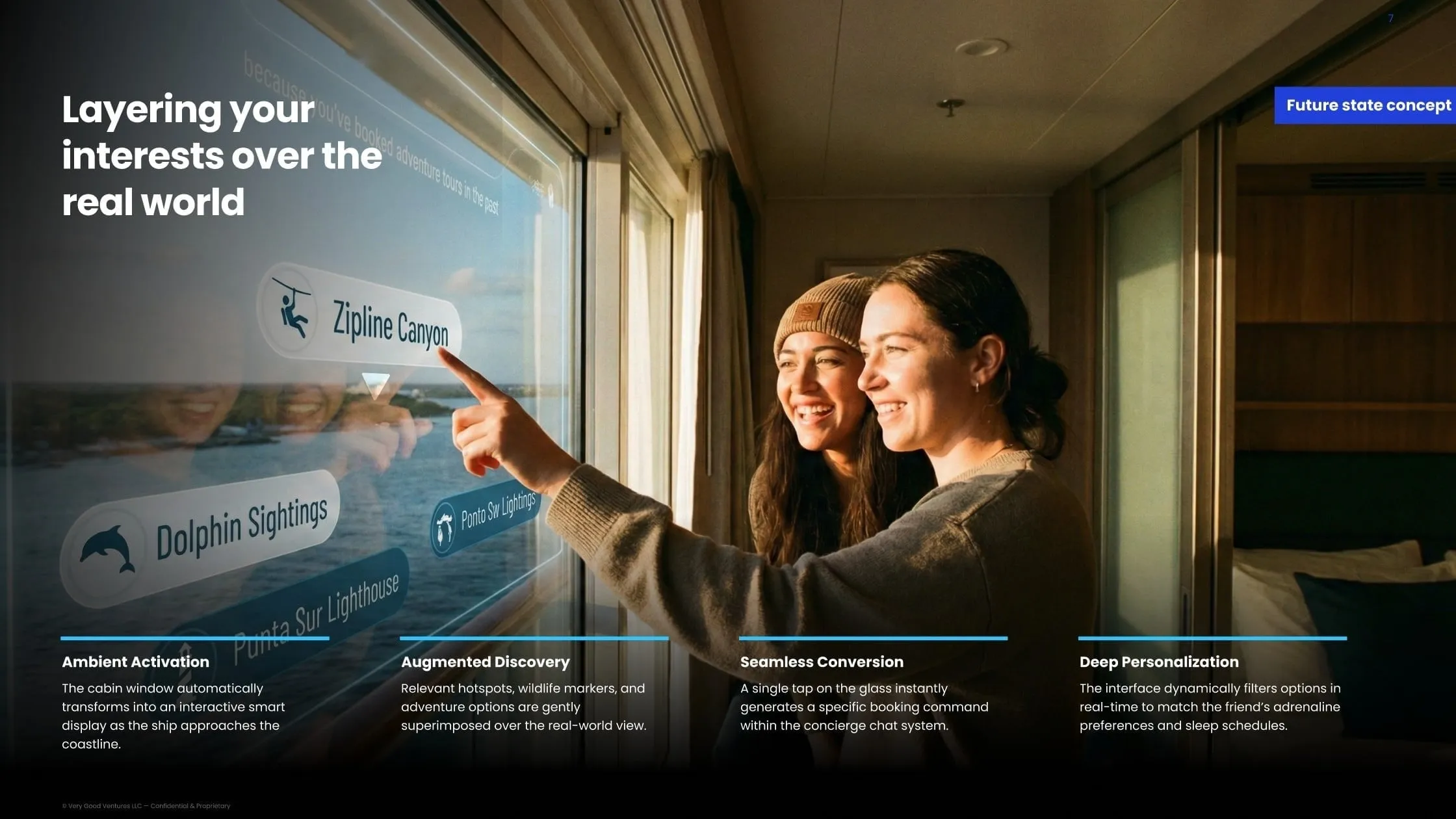
A cabin window that becomes a guide
As the ship nears the coast, the window becomes an interactive display. It layers hotspots, wildlife, and excursions over the real view, and a tap starts a booking in the concierge chat.
Roll credits.
Who did what, and with which tools.
- Client
- One of the world’s largest cruise lines
- Worked with
- The Flutter teamGoogle
- Built with
- Flutter GenUI SDKDart and Flutter
- Delivered
- Structured CreativityA working GenUI prototype
Built by Very Good Ventures
More success stories
All success stories
JSX moves off Xamarin to a Flutter app it owns

- test coverage
- 100%
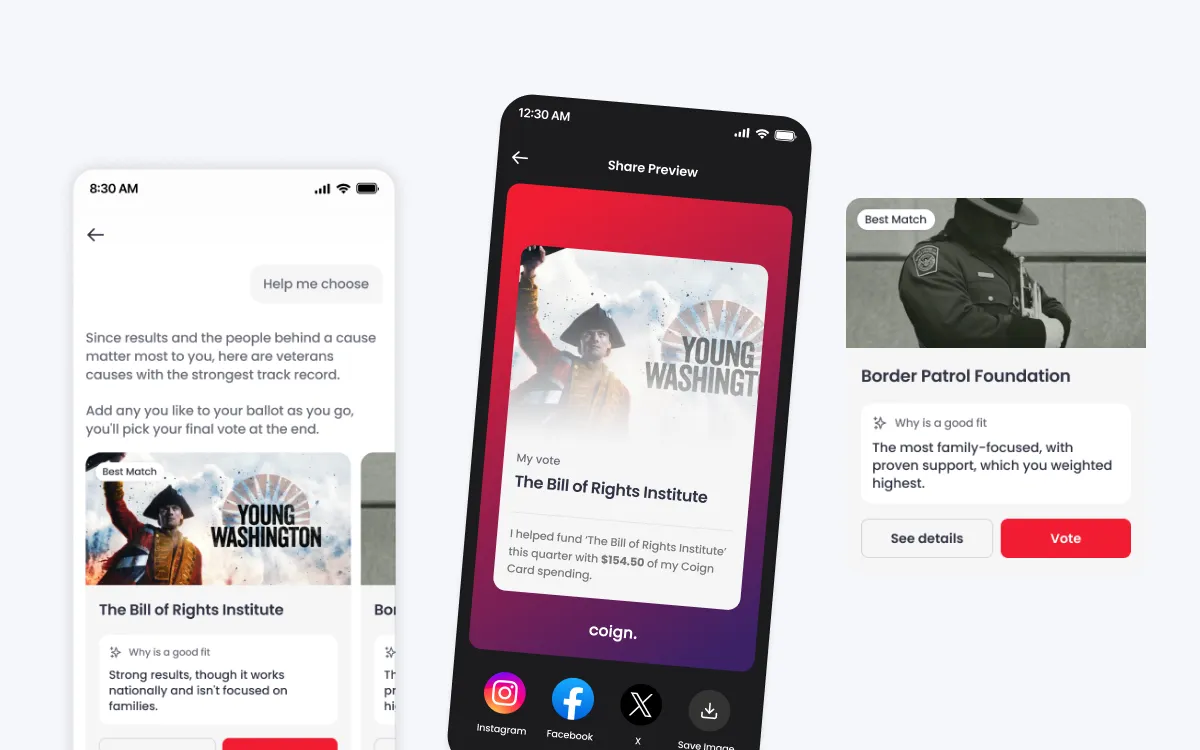
Generative UI for Coign

How VGV used GenUI to turn Coign’s quarterly charity vote into a personal way for cardholders to explore causes, vote, and share the impact they made.

Blade’s luxury travel app, rebuilt in Flutter

Reimagining Blade’s luxury travel experience with seamless booking, modern architecture, and a multi-platform mobile app built for speed, elegance, and scale.






We’ll care about your success as much as you do.
Our unicorns read every message and reply, usually the same day.
Start the conversationA 30-minute call about what you’re building.