


Keeping Up With PR Review in the AI Era
AI is having a large, positive impact on our industry, and as with any shift of this size, some of the processes around it have to adapt, and code review is one of those places teams are feeling something needs to change.
To be fair, PR review has always been a bottleneck: pull requests wait in a queue for a reviewer, who then has to switch context to read them, and changes sit unmerged in the meantime. The difference now is the scale, because reviewers who used to handle a few pull requests at a time are now facing many times that number, and the volume keeps growing as teams add more agents. Faros AI’s 2026 report, based on data from 22,000 developers, shows what happened to volume, review time and quality as AI adoption grew. The problem was there long before AI, but today it costs a lot more.
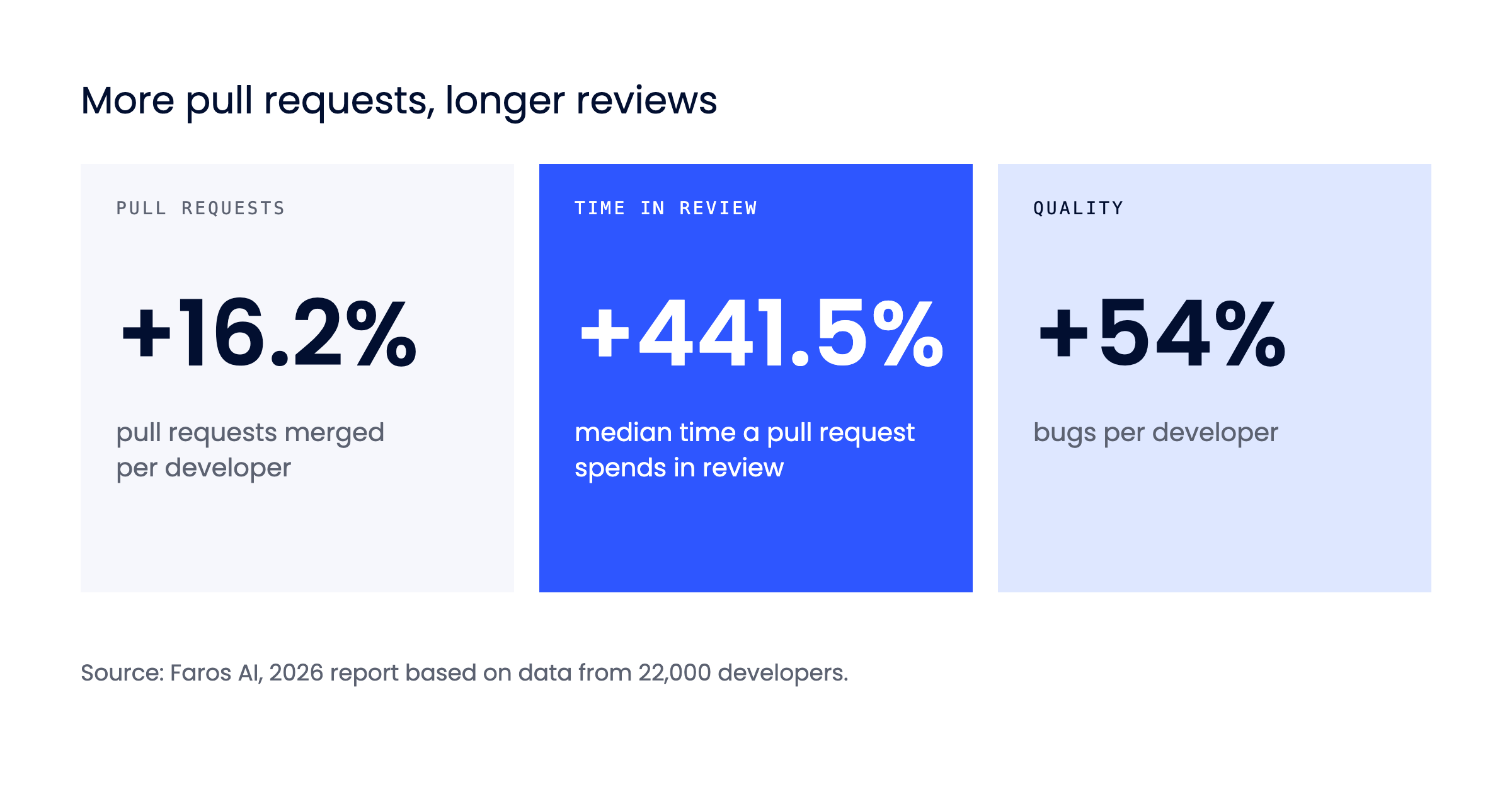
For the same reason, more AI spending on its own will not pay off. You can keep adding tools, agents, and tokens, but without guardrails around what gets merged, the extra output ends up waiting in the review queue, and velocity stops being the only thing you need to watch: quality, review time, and the hours your reviewers spend on each pull request matter just as much.
In this post, we look at what teams usually try, why it doesn’t solve the problem, and what a review process that can keep up looks like. In short, make every check the author’s responsibility, from automated gates to AI code review, so reviewers only see what needs their judgment, and turn repeated findings into new rules so each review makes the next one cheaper.
What teams usually try
When review starts slowing delivery down, most teams reach for one of three fixes. Each of them makes sense at first, but they all try to speed up the existing process instead of changing it, so none of them holds up as volume keeps growing.
-
Ask reviewers to go faster. With more pull requests in the queue and the same number of hours in the day, reviewers read less carefully, approvals turn into a formality, and the risk that review was meant to catch goes up without anyone noticing. The load also tends to fall on the few people who know the codebase best, who end up as overloaded gatekeepers for everything that ships. In Sonar’s 2026 developer survey, 38% of developers said reviewing AI-generated code takes more effort than reviewing code written by their colleagues.
-
Bring AI into review. Sometimes that means the reviewer asks their own AI assistant to review the change, which raises a fair question: if the review comes from an AI anyway, the author could have run that check before asking anyone. Other times it means adding an AI reviewer that comments on every pull request. AI review is useful, but used this way it adds comments rather than capacity: a reviewer still has to read every change, and now also has to read and sort through what the AI flagged. The issue is not the AI reviewer itself, but a process that still assumes a person reads every line.
-
Put more people on review. Spreading the load across more of the team helps for a while, but every hour someone spends reviewing is an hour taken away from other work, and people who know a part of the codebase less well review it with less confidence. Agents can multiply the number of pull requests at little cost, while review capacity only grows as fast as the people available to do it, so this approach cannot keep pace either.
At this volume, the useful question is no longer who reads every line, but what tells you a pull request is safe to ship.
Start review from the evidence
When someone reviews a pull request, what they need to know is whether the change is safe, secure and performant, and whether it does what was asked. Evidence has always been the best way to answer that: test results, end-to-end runs, visual regression checks, performance results against a baseline, and security scans. Producing that evidence used to be expensive, though: much of it took so long to build that many teams left it until the end of a project, if they built it at all, and relied on reviewers reading every line instead. AI has lowered that cost considerably, so the evidence can now scale with the number of pull requests, which line-by-line reading never could.
Most of that evidence is pass or fail, such as tests, lint rules, or security scans, and when it passes there is nothing for a reviewer to look at. The part that needs a person is what a check cannot judge on its own, such as a screen that now looks different or a new architectural approach. Showing those changes on every pull request tells the reviewer where to spend their time, and whether the change was intended is the question only they can answer.
A review process in four layers
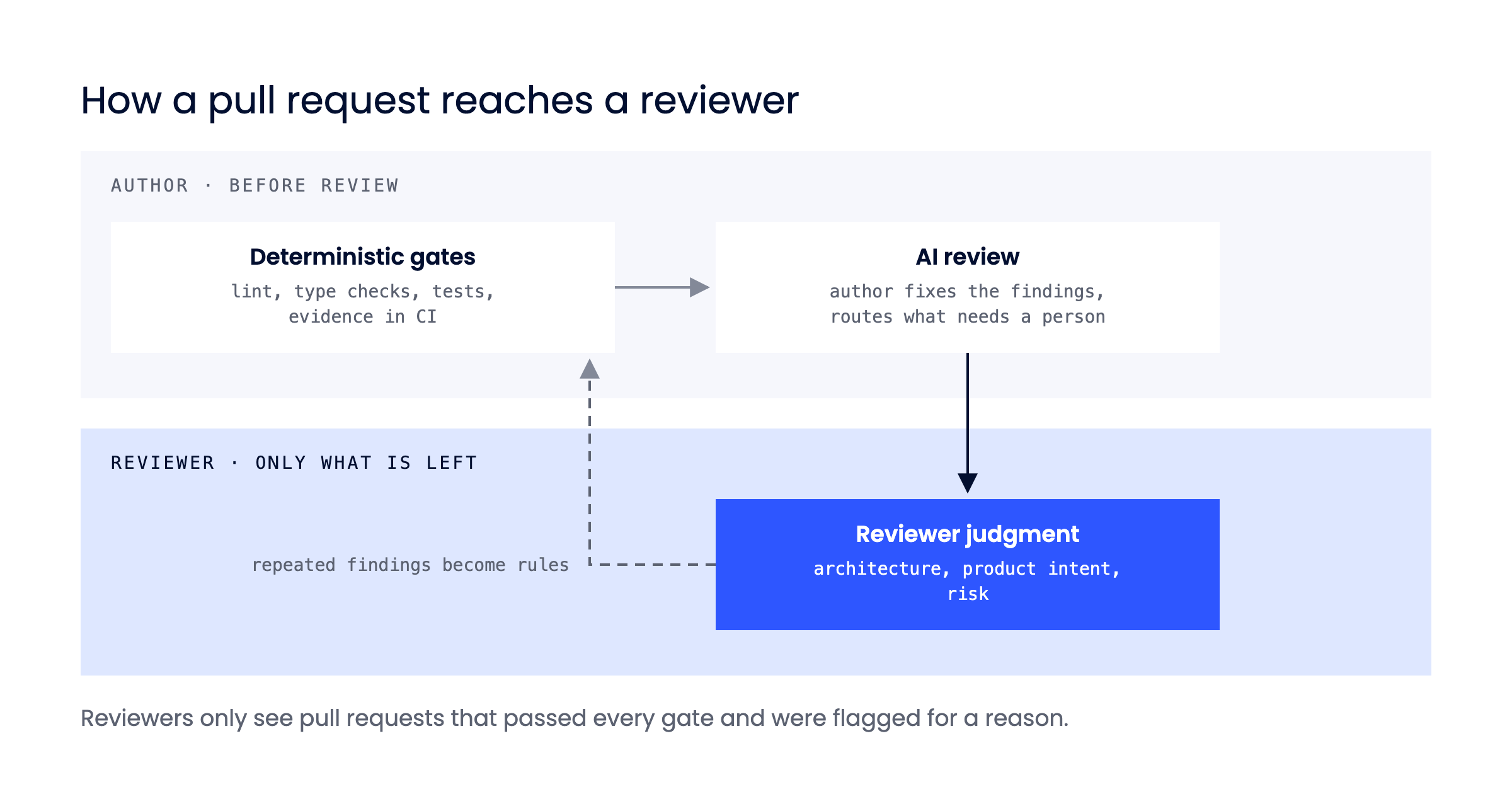
A review process that can keep up with agents works in layers, each handling what it does best, and the most important change is who owns each step: the checks belong to the author of the pull request, and a reviewer only starts once the pull request has passed them and carries its evidence.
Deterministic gates
Lint rules, type checks, and the tests and other evidence described above run on every pull request through CI. If they don’t pass, the pull request is not ready for review, and no reviewer should spend time on it. These gates catch everything a rule can catch, at almost no cost, and they behave the same way every time.
AI code review and triage
Next, an AI code reviewer runs automatically on every pull request. The review works best when it runs separately from the agent that wrote the code, with only the change, the repository, and the team’s rules, so it doesn’t carry the same assumptions and mostly confirm its own work. An author should not open a pull request so that someone else can review it with their own AI, so this step belongs to the author too, who works through the findings before asking for a person. On our projects, including our open source maintenance work, this is the job of Unicoder, the AI teammate we built for our own teams. It reviews every pull request before anyone else does and only approves once every issue it raised has been resolved, so by the time a reviewer opens the pull request, the routine problems are already gone.
The AI can also triage the pull request, pointing the reviewer to the parts that deserve their attention and flagging changes that may not need a person at all. Which changes qualify depends on each team’s standards, but most projects have some parts of the code, such as authentication or payments, that should always get a person, enforced with code owners or protected paths rather than left to the AI’s triage. How many of those parts there are depends on the project.
Reviewer judgment
The pull requests that reach a reviewer have already passed every gate and were flagged for a reason. Reviewers start from what the checks and the AI review could not decide on their own, and spend their time on what only a person can judge: architecture, product intent, and risk. For the reviewer’s side of this in more detail, see what changes about code review when AI writes your code.
The feedback loop
When the same finding keeps coming up in review, it becomes a custom lint rule or a new check in the first layer, so next time it is caught earlier and on the author’s side, and every review makes the next one cheaper. The same finding can also go into the instructions coding agents read before they write code, such as a repository’s agent guidelines, so agents are less likely to repeat the mistake, although an agent can still ignore an instruction, which is why the rule or check comes first.
Over time, this process also gives leaders a view they rarely have today: which parts of the codebase draw the most flags, failures and rework, and how much reviewer time goes into review.
Where to start
AI has made writing code cheap, and review has to change to keep up. When the checks belong to the author, AI review handles the routine findings, and the feedback reviewers keep repeating turns into rules, reviewers can spend their time on the decisions that need them without slowing delivery down.
To start with the AI review layer, Unicoder, the AI coding teammate we built for our own teams, reviews every pull request we open and is now open to other teams through its waitlist. To see where your own pull requests wait today, our PR-to-Prod Check measures review time, CI time and the path to main across up to three of your repositories, and ranks which fixes to make first. If your team is running into these problems, get in touch and let’s see how we can help.
Get our insights
Get the next post in your inbox, written by the team that shipped the work.
 From the VGV unicorns