





This fintech card issuer had always grown by adding people. With applications about to reopen, that model was running out of room. VGV joined the issuer’s team to find where AI could carry the load, trained staff on Claude, and stood up two pilots now run by the people already doing the work.
- Of previously undetected transactional fraud projected to be mitigated
- 80%
- To produce a complete newsletter draft, a job that used to take about a week
- 5 min
- Real transaction records used to validate the fraud detection engine
- 1M+
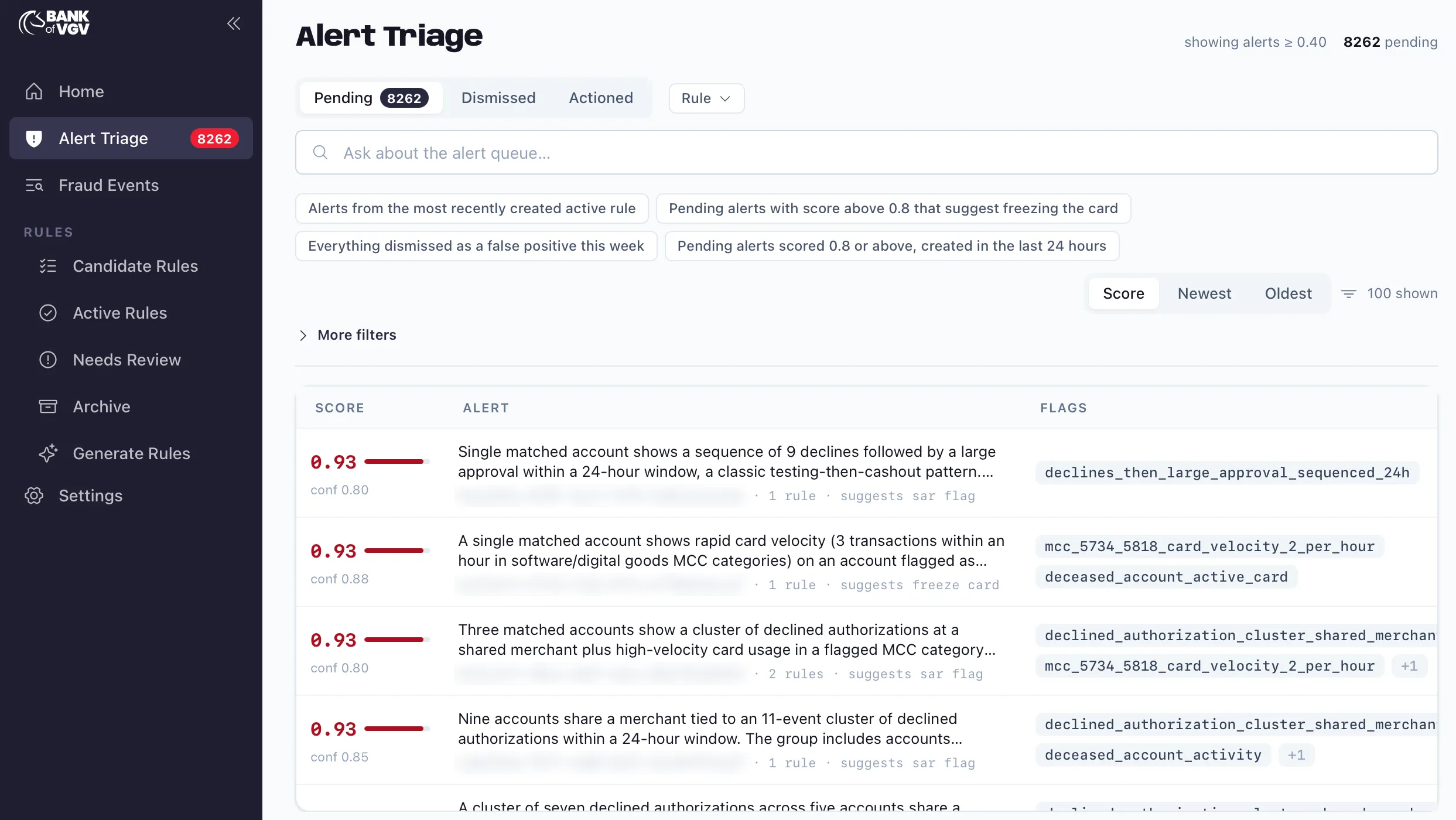
The fraud review portal, Alert Triage: 8262 pending alerts ranked by score, each with a summary, the rules it matched, its flags and a suggested next step. Open an alert to dismiss it or take the suggested action. Two suggested queries filter the queue.
Ask about the alert queue...
01At a glance
Scaling the team without scaling headcount
-
01
The challenge
The issuer had grown by adding people. With applications set to reopen, marketing and fraud would feel the pressure first, and neither could hire fast enough to keep up.
-
02
Our approach
We interviewed 14 stakeholders across six departments, consolidated 91 pain points, and scored each one on value, effort, risk, and maintenance. We trained the team on Claude and chose two pilots each department could own.
-
03
The results
An AI-ranked fraud alert layer, validated on 1M+ real records, projected to catch 80% of fraud that previously went undetected. Newsletter drafts in 5 minutes instead of about a week. The client approved a follow-on engagement before the first pilot wrapped.
02The challenge
A growth curve the issuer couldn’t hire its way through
The client is a fintech credit card issuer with a lean team. For years it absorbed operational friction the usual way, by adding people. That held while new applications were paused. It would not hold once they reopened.
The company’s co-founder and CEO told us at kickoff that the pressure would hit departments in sequence. Marketing would feel it first as acquisition volume climbed. Customer service would follow. Fraud exposure would grow with every new account.
Marketing ran on two people, and every email cleared a slow approval chain that ended with the sponsor bank. Even a button color change could take a week. In fraud, the data needed to catch cross-account fraud rings already flowed through the issuer’s pipeline. Nothing was watching it for patterns, so rings surfaced only after the damage was done.
The issuer wanted to get ahead of its next wave of growth—with AI built into daily work and in the hands of the teams who know it best.
In their words
- Fintech card issuer
“Having been in this industry for however long it’s been, it’s just crazy what you can do with AI... it is pretty wild”
Chief Technology Officer
03The fraud pattern alert layer
From hiring ahead of growth to an AI-first team
The fraud review portal built with the issuer’s team. Fraud experts describe suspicious patterns in plain language, and the system generates the rules that flag them across accounts. Claude ranks every alert by severity, removes duplicates, and suggests a next step, so analysts review the riskiest cases first.
04The fraud pilot
Watching patterns nobody had time to watch
The issuer’s fraud data already existed. Login events, transaction authorizations, and app navigation logs flowed into a working pipeline. What was missing was something watching across accounts. Now its fraud experts describe a pattern in plain language, and the system generates the rule and the evals to catch it. We proved it out on five test cases, from shared IP addresses to geographically impossible card-present transactions.
A Claude layer then ranks each alert by severity, removes duplicates, and suggests a next action. Every recommendation stays informational, and analysts make every call. Midway through the build, the team moved the review interface from an off-the-shelf tool to a custom portal. We validated the engine against more than one million real records before it moved to production.
Before and after: how fraud review starts
Before
Multiple manual checks. Each one only happened if an analyst remembered to look.
- Customer transactions Raw event stream
- Mobile app activity Raw event stream
- Visa system Raw event stream
- Login events Manual check
- Device tokens Manual check
- Known-fraud merchants Manual check
Time
After
One view watches every system: customer transactions, mobile app activity, Visa, login events, device tokens, and known-fraud merchants. The system triggers the review and recommends what to do next.
- Automatic trigger
- Fraud review portal
- Analyst reviews
- Action
For example
- Lock the account
- Update Visa to auto-decline
Time
05Our approach
Start with the people doing the work
Listening before building
We ran 14 structured interviews across six departments: fraud, customer service, marketing, operations, data and analytics, and technology. More than 100 raw issues consolidated into 91 pain points and 10 cross-cutting themes. Cross-system data reformatting alone accounted for 21 of them.
We scored every pain point on value, effort, risk, and long-term maintenance, which produced 12 ranked recommendations. Two rose to the top. Each could be owned by a single department, shared no upstream systems with the other, and needed only the issuer’s internal sign-off rather than a sponsor-bank review.
From workflow mapping to 2 solutions in production
- 14 Interviews mapping critical workflows
- 91 Pain points and bottlenecks
- 10 Cross-cutting themes
- 12 Scored AI opportunities
- 2 AI solutions running in production
- Marketing Marketing production pipeline A Claude plugin of skills and agents that plans, drafts, routes for approval, and revises campaigns.
- Fraud Fraud pattern alert layer Fraud experts describe patterns in plain language, and the system generates the rules and evals. Claude then ranks, deduplicates, and recommends next steps.
Each started as a six-week pilot owned by a single department and cleared with the issuer’s internal sign-off
Training the team on Claude first
Alongside the pilots, we ran an AI Literacy program. Three 2.5-hour sessions ran on two tracks, one for executives and one for individual contributors. Teams worked through Claude fundamentals and prompting, reusable projects, and extending Claude with skills, subagents, connectors, and Cowork automation. People learned on their own work, so the habits held after the sessions ended.


Claude Partner Network · Select Services Partner
Built by a team that ships with Claude every day
VGV is a Select Services Partner in the Claude Partner Network, and our AI engineers are Anthropic-certified. The same people who trained the issuer’s staff built the pilots alongside them, so what we teach comes from what we ship.
06The marketing pilot
A skill suite for a two-person team
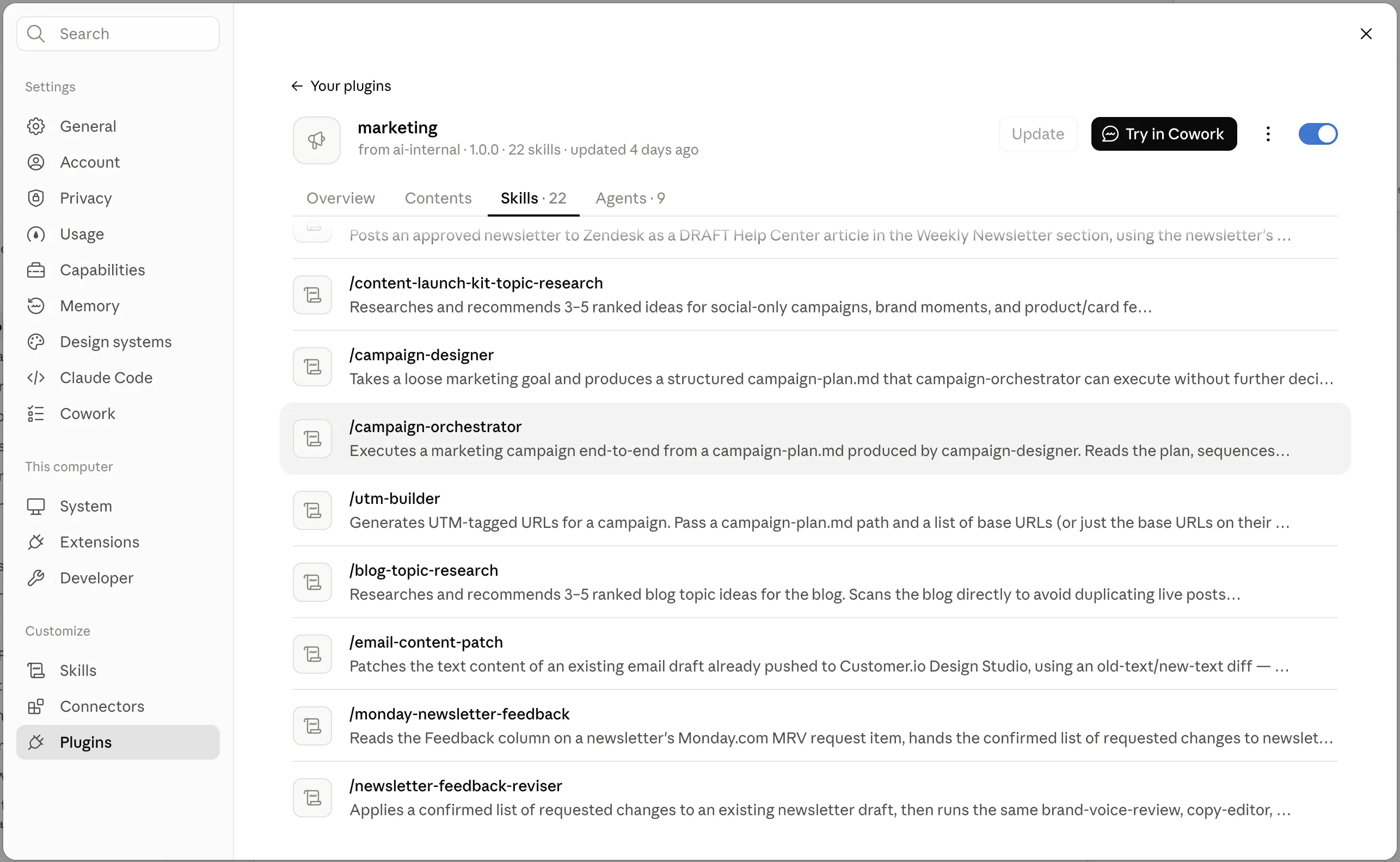
We packaged the issuer’s marketing workflows into a Claude plugin of skills and agents. A Campaign Designer turns a loose goal into a structured plan. A Campaign Orchestrator carries that plan out end to end. Eight sub-agents run inside those skills, covering brand voice, copy editing, SEO, competitor research, backlinks, social media, and internal communications.
The suite plugs into the tools the team already used. It builds emails in the marketing platform, routes newsletters for bank compliance approval, submits them to the review board, reads reviewer feedback, and applies the requested revisions. The team kept its process. The repetitive steps moved to Claude. In the first end-to-end test, a complete newsletter draft took about five minutes.
Built to stay with the team
We designed both pilots to be run by the people already doing the work. The issuer’s fraud analysts send feedback and request improvements directly, and a connector lets them query the fraud portal from Claude. Marketing runs its suite without waiting on engineering time.
Because each team helped design the tools it was trained on, the gains compound after we leave instead of decaying. The pattern travels to any department. We interview the team, rank the pain points by ROI, train everyone on Claude, and build agents where the math is obvious.
07What’s next
Agents that work while the team sleeps
The pilots put Claude into the daily work of two departments. The next step is teaching the issuer’s teams to build agents that run on their own. These agents don’t wait for someone to open a chat. They run on a schedule overnight and hand people a finished starting point each morning.
In fraud, that means an agent that sweeps the previous day’s activity against a growing pattern library, so a ranked review queue is waiting when analysts log in. In marketing, it means topic research, first drafts, and performance summaries ready before the workday starts.
We’ll train the teams to design, schedule, and monitor these agents themselves, with the same guardrails as the pilots. Agents recommend, people decide, and IT controls what each agent can reach. The goal is for the issuer to keep adding agents long after our engagement ends.
Roll credits.
Who did what, and with which tools.
- Client
- Fintech card issuer
- Services engaged
- AI StrategyAI Literacy TrainingClaude Skills & AgentsAgentic Solutions
- Built with
- ClaudeClaude skills and agentsA connector to the fraud portal
- Delivered
- A fraud pattern alert layerA marketing skill suiteAI Literacy training on two tracks
- Notes
- The 80% figure is a projection from the client’s data leadership. The newsletter result reflects the first end-to-end test.
Built by Very Good Ventures
More success stories
All success stories
Betterment’s GraphQL generator, rebuilt with Claude

- faster tickets, days down to hours
- 10x
- project output, 6 epics in 3 months
- 2x
- faster builds, v2 vs. v1
- 38%

Dow Jones cuts development cost 50% with Flutter

- lower development cost
- 50%

Nav doubles user growth with Flutter

- user growth
- 2x
- engagement increase
- 200%




We’ll care about your success as much as you do.
Our unicorns read every message and reply, usually the same day.
Start the conversationA 30-minute call about what you’re building.