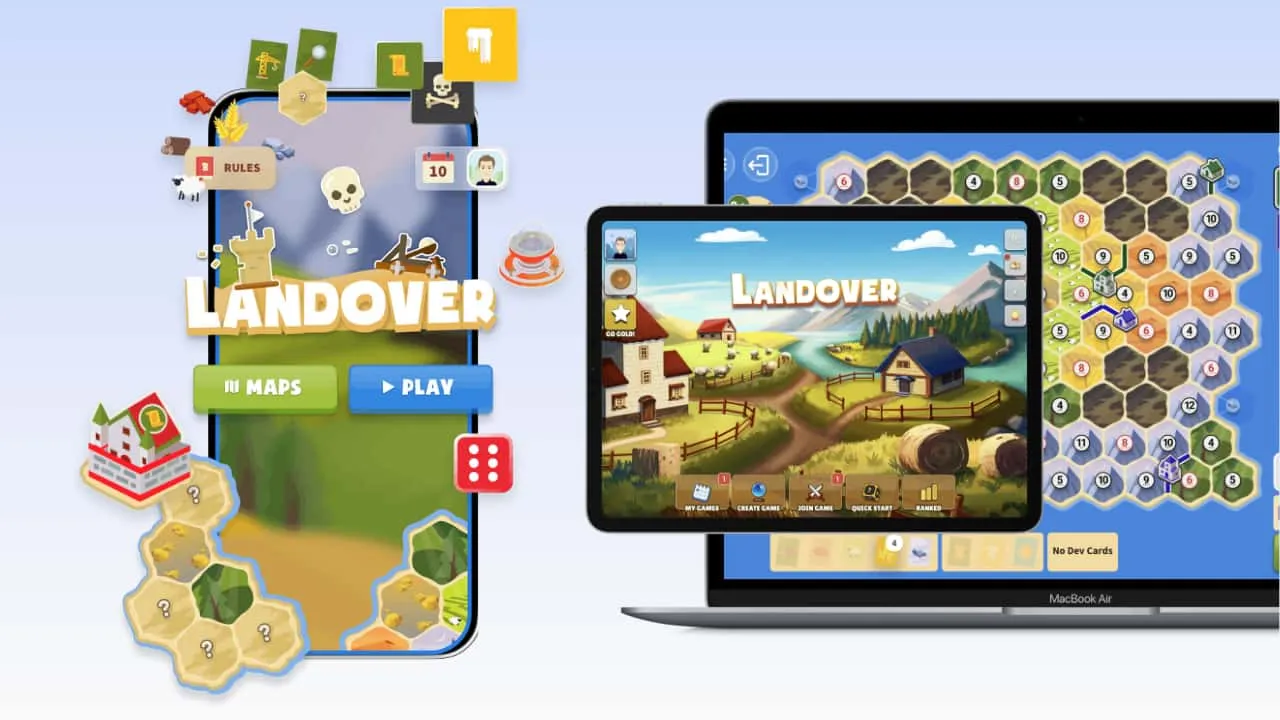
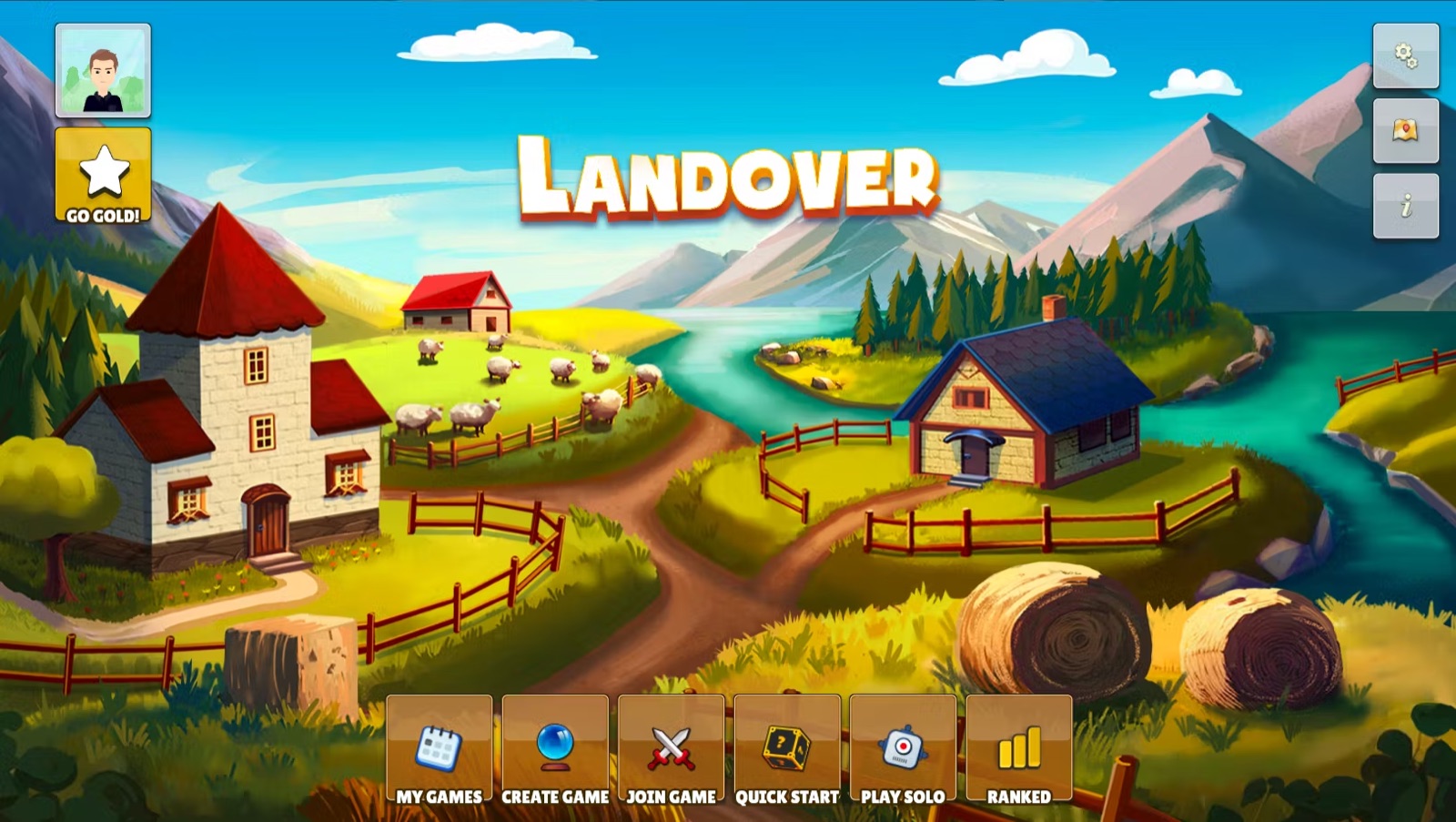
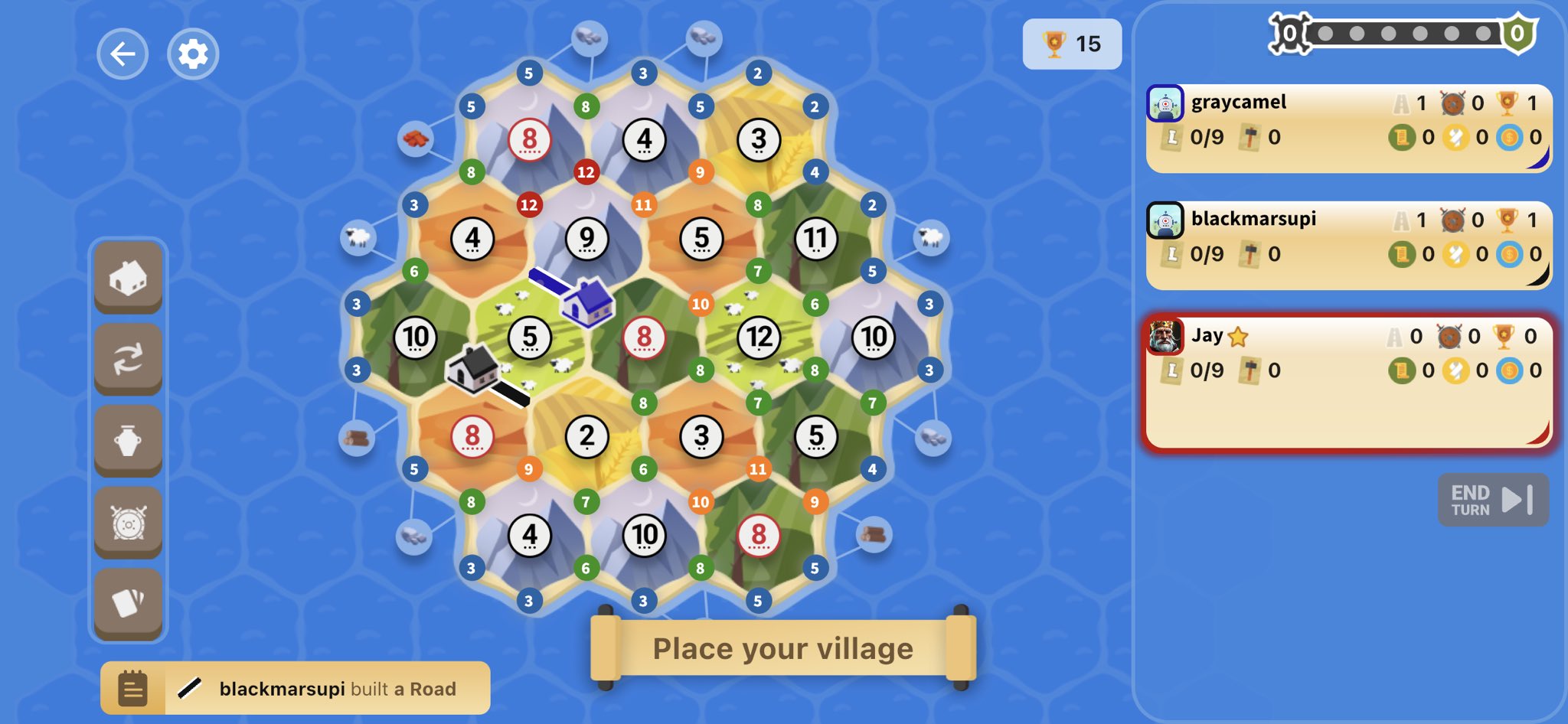
Landover is a Catan-inspired strategy board game that transports you to a vibrant world of islands and resources. Play solo games against a wide array of different bots all with varying skill levels, personalities, and play styles. Or play up to 8 player games on giant maps with friends, family, or other Landover community members!
The Challenge
Landover.io set out to build a modern strategy board game inspired by Settlers of Catan (including its Cities & Knights and Seafarers expansions), but fully reimagined for digital play across both mobile and web. The goal wasn’t simply to digitize a board game, but to create an engaging, scalable, and competitive experience that worked seamlessly on every device. To achieve this, the team faced several significant challenges:
-
Cross-Platform Performance Demands: Delivering smooth, native-like performance across iOS, Android, and web browsers with one unified codebase.
-
Real-Time Multiplayer Synchronization: Ensuring accurate, low-latency state management for multiple players across devices during live matches.
-
Complex Game Logic: Replicating nuanced rules, expansions, and dynamic map creation in a backend system while keeping the experience intuitive for users.
-
Scalable Architecture: Designing infrastructure that could handle thousands of concurrent games and future growth.
-
Consistent User Experience: Adapting layouts, interactions, and visuals for small mobile screens and large web browsers without compromising usability.
-
Competitive Features & Monetization: Supporting rankings, premium subscriptions, and custom maps to keep players engaged and generate revenue.
Our Solution
To solve Landover’s unique challenges, the Very Good Ventures team defined a clear technical and design strategy. The goal was to create a scalable, real-time game that could live on both mobile and web without sacrificing performance or user experience. We accomplished this by combining cross-platform development, real-time backend services, and a user-first design philosophy, including:
-
Building once, deploying everywhere with Flutter so the same codebase powered iOS, Android, and web experiences.
-
Running multiplayer logic on Firebase using Firestore, Cloud Functions, Authentication, Hosting, and other services to keep games synchronized in real time.
-
Designing for consistency across devices, with responsive layouts and adaptive game mechanics that felt natural on both small screens and larger browsers.
-
Supporting growth and competition from the start by enabling features like custom maps, premium subscriptions, and ranking systems.
-
Delivering in iterations rather than all at once, launching early betas to validate mechanics, stress-test infrastructure, and gather real user feedback.
How We Did It
Once the strategy was set, the team shifted to execution. Delivering a real-time strategy game across platforms required disciplined architecture, careful workflow management, and continuous iteration. Our process balanced backend reliability, frontend polish, and rapid feedback cycles to ensure stability and scalability.
-
Architecture & Backend Development
-
Defined a robust backend architecture using TypeScript and Node.js to handle complex game state, logic, and synchronization.
-
Leveraged Firebase’s real-time services (Firestore, Cloud Functions) to provide a reliable source of truth for every game instance.
-
-
Frontend & Cross-Platform Adaptation
-
Built a responsive UI with Flutter to ensure one codebase worked seamlessly across devices.
-
Tailored layouts and interactions so the experience felt intuitive whether played on a phone, tablet, or browser.
-
-
Testing & Iteration
-
Validated core game mechanics (resource distribution, dice rolls, expansions) early in the build.
-
Expanded gradually with new features and refinements, guided by extensive playtesting and bug tracking.
-
-
Organization & Project Management
-
Adopted a Kanban-style workflow for clarity on tasks, timeframes, and ownership.
-
Scaled the team using staff augmentation when additional expertise was required.
-
-
Launch & Feedback Loop
-
Released an open beta to validate real-world usage and capture user feedback.
-
Used analytics and player insights to refine performance, balance gameplay, and improve engagement.
-
The Result
-
Reached over 19,000 monthly active players, proving demand and validating the stability of the platform at scale.
-
Delivered a seamless cross-platform experience, where users could jump between iOS, Android, and web without losing quality or performance.
-
Introduced competitive and monetization features, including premium subscriptions, player rankings, and support for custom/user-created maps that kept the community engaged.
-
Earned international recognition, with support from the Uruguayan Government to showcase Landover at the Game Developers Conference (GDC) in California.
-
Achieved a technical milestone, becoming one of the first real-time strategy games successfully built and launched in Flutter.,
-
Created a foundation for future growth, with an architecture designed to expand as new features, modes, and player communities emerge.